Most drivers never think about tow trucks until they are stranded on the side of the road. And when that moment hits, the natural instinct is to call the nearest towing service and trust that they will handle everything. But here is something most people do not know: not all tow trucks work the same way, and using the wrong type for your vehicle can cause real, costly damage.
This guide breaks down the three main types of tow trucks, explains how each one works, and helps you figure out which is the right fit for your specific vehicle. Whether you drive a front-wheel drive sedan or an AWD crossover, knowing this before you need it can save you money and stress. If you are in the Cary area and need a tow you can count on, reach out to us at Agile Towing Company by calling (919) 276-5900.
Why the Type of Tow Truck Matters
The type of tow truck used on your vehicle makes a bigger difference than most people realize. Using the wrong method, such as towing an all-wheel-drive vehicle by only two wheels, can put serious stress on the transmission, drivetrain, and axle components. That kind of damage can be costly to repair and is entirely avoidable with the right equipment.
Towing is not one-size-fits-all. Each truck type is designed for specific situations, and matching the right method to your vehicle is the first step toward making sure it arrives at its destination in the same condition it left.
The Three Main Types of Tow Trucks
Hook-and-Chain Tow Trucks
Hook-and-chain trucks are the oldest towing method still in occasional use. They work by looping a chain around the vehicle’s axle or frame and dragging it with one end partially lifted off the ground.
This method was once the industry standard, but it has largely been replaced for passenger vehicles due to the risk of damage to bumpers, axles, and undercarriage components. The metal-on-metal contact and uneven pressure make it a poor fit for most modern cars.
Hook-and-chain towing is still used in specific situations, mainly for heavily damaged vehicles or cars being transported to a salvage yard where condition is no longer a concern. For a routine breakdown, there are better options available.
Wheel Lift Tow Trucks
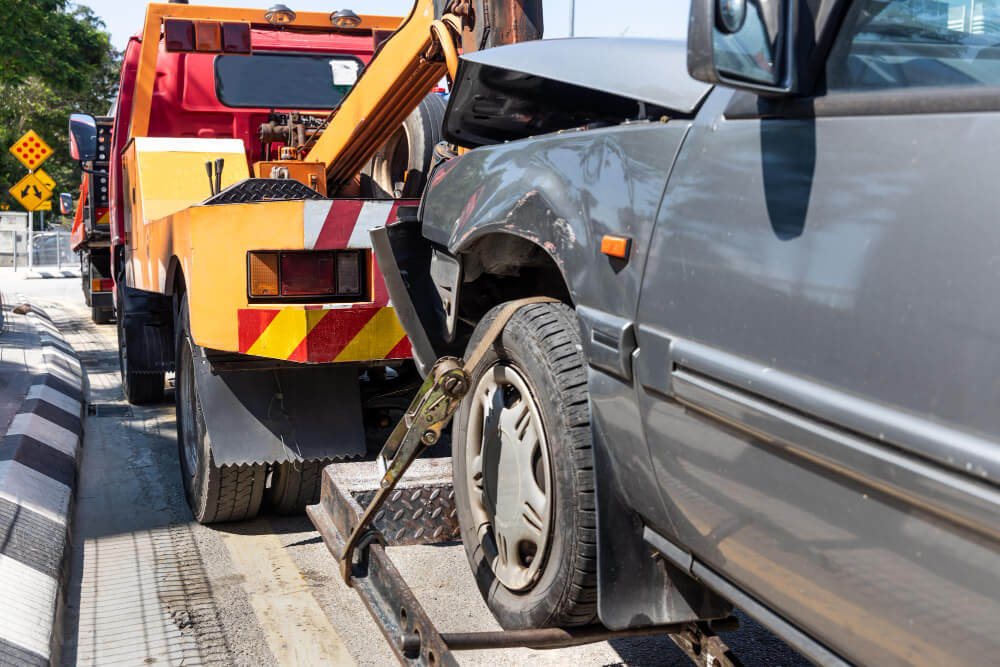
A wheel lift tow truck uses a metal yoke that slides under either the front or rear wheels, cradles them, and lifts one end of the vehicle off the ground while the other two wheels roll along the road. It is a faster and more efficient method than flatbed towing and works well for many standard passenger vehicles in everyday breakdown situations.
That said, wheel lift towing comes with an important condition: the wheels that stay on the ground must be the non-drive wheels. This means the operator needs to know your drivetrain type before connecting.
Here is why that matters:
- Front-wheel drive vehicles should be lifted from the rear, keeping the drive wheels off the road.
- Rear-wheel drive vehicles should be lifted from the front, for the same reason.
- AWD and 4WD vehicles should generally not be towed with a wheel lift. Because all four wheels are mechanically linked in these drivetrains, dragging any two of them along the road can cause serious damage to the transfer case, differentials, and drivetrain components.
Wheel lift towing is a practical, widely used method. It just requires the right knowledge and application to be done safely.
Flatbed Tow Trucks
A flatbed tow truck carries the entire vehicle on a flat, open platform, keeping all four wheels completely off the ground. The platform tilts hydraulically to road level, the vehicle is driven or winched onto it, and then secured for transport.
This is the safest towing method for most vehicles and the clear choice for:
- AWD and 4WD vehicles of any kind
- Low-clearance sports cars and performance vehicles
- Luxury vehicles where cosmetic protection is a priority
- Cars with significant undercarriage damage or uncertain mechanical condition
Because no wheels touch the road during transport, there is no drivetrain risk and far less chance of damage to any part of the vehicle. Flatbed towing is also the most versatile option overall, making it a safe default when there is any doubt about the right approach.
How to Match Your Car to the Right Tow Truck Type
You do not need expert knowledge to figure out what your vehicle needs. A few simple questions can point you in the right direction.
Does your car have all-wheel drive or four-wheel drive? If yes, a flatbed is the safest option. This applies to most modern SUVs, crossovers, and trucks.
Is your car front-wheel or rear-wheel drive with no existing damage? A wheel lift tow truck can be a safe and efficient choice, as long as it is connected to the correct end.
Does your car have low ground clearance, undercarriage damage, or significant body damage? Go with a flatbed regardless of drivetrain.
When in doubt, the flatbed is always the safer default. It works for virtually every vehicle type and removes the guesswork entirely.
What to Tell the Towing Company When You Call
Knowing a few basic details about your vehicle before you call helps the dispatcher send the right truck the first time. A reputable towing company will typically ask these questions, but going in prepared speeds things up and gives you more confidence in the process.
Have this information ready:
- Your vehicle’s year, make, and model so drivetrain type can be confirmed if needed.
- Your drivetrain type, whether that is front-wheel drive, rear-wheel drive, AWD, or 4WD.
- Any existing damage to the undercarriage, wheels, or bumpers that could affect how the vehicle is moved safely.
- Your exact location so the right truck gets routed to you without delay.
A professional towing service should ask about your vehicle before dispatching. If a company sends a truck without any of these questions, that is worth noting.
Knowing the Difference Protects Your Vehicle
The three types of tow trucks each serve a different purpose. Hook-and-chain trucks are mostly outdated for everyday use. Wheel lift tow trucks are efficient and appropriate for many standard vehicles, but only when matched correctly to the drivetrain type. Flatbed tow trucks are the safest and most versatile option, and the only truly appropriate choice for AWD, 4WD, and specialty vehicles.
Having this knowledge ready before you make that call can protect your car from unnecessary damage and help you feel more in control of a stressful situation.
If you are in the Cary area and need towing from a team that asks the right questions and uses the right equipment, give us a call at Agile Towing Company. You can reach us at (919) 276-5900. We are here to make a frustrating situation as simple and straightforward as possible.